03 July, 2025
Best Garments ERP Software in Bangladesh
Discover the best garments ERP software in Bangladesh for Dhaka-based RMG factories. Manage merchandising, inventory, production, HR, payroll, accounts, quality control, and shipment tracking from one smart ERP solution built for garment businesses in Dhaka, Gazipur, Savar, Ashulia, Narayanganj, and nearby areas.
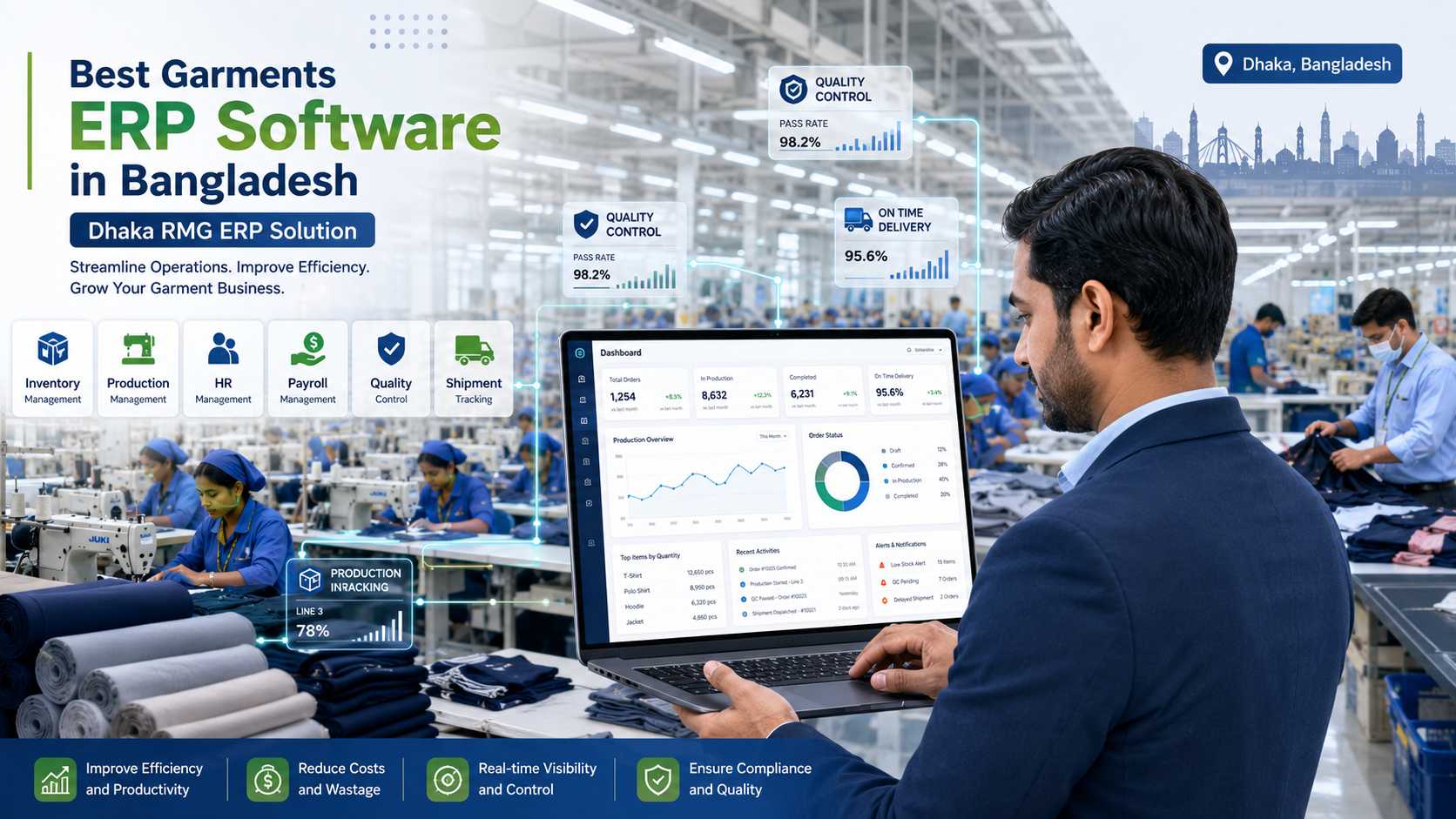
The best garments ERP software in Bangladesh is a complete, locally adaptable ERP system that helps garment factories manage merchandising, inventory, production, HR, payroll, accounts, quality control, commercial documentation, and shipment tracking from one platform. For factories in Dhaka, Gazipur, Savar, Ashulia, Narayanganj, Tongi, Keraniganj, and nearby RMG zones, the right ERP should reduce manual work, improve real-time visibility, control production costs, and help management make faster decisions.
Bangladesh’s apparel industry is one of the country’s strongest export sectors. BGMEA data compiled from the Export Promotion Bureau shows Bangladesh’s apparel exports reached about $39.35 billion in FY 2024–25, growing 8.84% compared with FY 2023–24. That scale explains why garment factories now need more than Excel sheets, manual registers, and disconnected accounting software. They need a factory-ready ERP solution built for the daily reality of Bangladesh’s RMG business. SK Soft Solutions is a Dhaka-based software and IT solutions company offering custom software, POS software, Garments ERP, websites, and mobile apps for businesses in Bangladesh. Garments ERP software is an integrated business management system designed for apparel, textile, and ready-made garment factories. ERP stands for Enterprise Resource Planning, which means it connects different departments into one centralized system. For a garment factory, this usually includes: In simple words, garments ERP software helps factory owners and managers see what is happening across the business without depending on separate Excel files, paper reports, or delayed department updates. Dhaka is not only the capital of Bangladesh; it is also a key business center for garment manufacturers, buying houses, exporters, suppliers, software companies, logistics providers, and commercial teams. Many factory owners operate their head offices in areas such as Gulshan, Banani, Uttara, Mirpur, Tejgaon, Mohakhali, Motijheel, Dhanmondi, Badda, Rampura, and Jatrabari, while production units may be located in Gazipur, Savar, Ashulia, Narayanganj, Tongi, Keraniganj, Dhamrai, or Narsingdi. This creates a common problem: the head office and factory floor are often not working from the same real-time data. A Dhaka-based merchandising team may confirm a buyer order in the morning. The store team in Gazipur may receive fabric in the afternoon. The production team in Ashulia may start cutting the next day. The accounts team in Dhaka may not see the updated costing until much later. Without ERP, every department works separately, and management only discovers problems after delays have already happened. A strong garments ERP solution solves this by creating one connected system for all departments. Many garment factories in Bangladesh still depend heavily on Excel sheets, WhatsApp updates, phone calls, and paper-based production reports. This may work for a small order, but it becomes risky when the factory handles multiple buyers, styles, colors, sizes, lines, and shipment dates. Common mistakes include: ERP reduces these problems by keeping data in one system. Fabric, trims, buttons, zippers, labels, poly bags, cartons, and accessories must be tracked carefully. A small mismatch can delay cutting, sewing, finishing, or packing. For example, a factory in Narayanganj may receive fabric for a knitwear order, but if trims are not available on time, sewing cannot continue properly. A factory in Gazipur may have fabric in the store, but if the ERP does not show accurate stock, the merchandising team may make wrong commitments to buyers. A garments ERP system helps track: Production delay is one of the biggest challenges in Bangladesh’s RMG sector. Delays may happen due to fabric shortage, machine breakdown, operator absence, wrong planning, quality rejection, or late buyer approval. ERP helps management see: This is especially useful for factories in Savar, Ashulia, Gazipur, and Dhaka EPZ, where large production volumes require strong coordination. A garment factory can lose profit even when it ships on time if the cost is wrong. Costing errors often happen because fabric consumption, trims cost, washing cost, printing cost, embroidery cost, commercial cost, labor cost, and overhead are not updated properly. A good ERP helps factory owners compare: International buyers expect proper documentation, traceability, HR records, quality reports, and shipment accuracy. Bangladesh’s garment sector has made major progress in safety and compliance, but factory owners still need strong internal systems to maintain records and reduce operational risk. BIDA notes Bangladesh’s RMG sector has become more transparent and compliant after major safety and responsibility initiatives, including Accord, Alliance, and the RMG Sustainability Council. ERP does not replace legal, safety, or compliance responsibilities, but it helps factories maintain cleaner records and better reporting. The merchandising module is the heart of garments ERP. It should help teams manage buyer inquiries, sample requests, order confirmation, costing, BOM, and production follow-up. A strong merchandising module should include: Expert advice: Choose ERP software that tracks buyer order history by style, season, shipment date, and costing version. This helps avoid confusion when buyers change quantity, color, trims, or delivery terms. A garment factory cannot run smoothly without accurate store management. Inventory mistakes can stop production even when orders are confirmed. The ERP should manage: For factories in Mirpur, Tejgaon, Narayanganj, and Keraniganj, inventory may involve smaller but frequent orders. For factories in Gazipur, Savar, Ashulia, and Tongi, inventory may involve larger warehouses, more production lines, and higher transaction volume. Production planning is where many factories lose time. The best garments ERP software in Bangladesh should provide real-time production planning and line monitoring. Important features include: A practical ERP dashboard should answer this question quickly: Can we ship this order on time? Garments production has multiple stages. If one stage is delayed, the whole shipment can be delayed. ERP should track: This gives management a real-time view of work-in-progress. Quality control is not only about final inspection. It should start from raw material checking and continue through inline, end-line, finishing, and final inspection. A garments ERP should support: Common client mistake: Many factories track quality only after production is almost finished. This is risky because repeated defects are discovered too late. ERP should help identify defects while the order is still in production. Garment factories often employ hundreds or thousands of workers. Manual attendance and payroll can create mistakes, delays, and worker dissatisfaction. ERP should manage: Factories in Savar, Ashulia, Gazipur, and Dhaka EPZ especially need strong HR and payroll integration because workforce size is usually large and shift-based. Garments ERP should connect operations with accounts. If production and inventory data are not connected with finance, management cannot see true profitability. Useful finance features include: For factory owners in Dhaka, this gives better control over cash flow, supplier payments, and buyer receivables. Export-oriented garment factories need accurate documentation. ERP can help commercial teams prepare and track documents more efficiently. Useful features include: This is important for factories serving international buyers from the USA, Europe, Canada, Australia, and other markets. The best ERP is not always the most expensive system. The best ERP is the one that fits your factory workflow, team capacity, buyer requirements, reporting needs, and long-term growth plan. Here is a practical comparison: For Bangladesh’s RMG industry, a garments-specific or custom garments ERP is usually better than a generic ERP because it understands style, buyer, color, size, fabric, trims, line production, and shipment workflow. Imagine a mid-sized garment factory with a head office in Uttara and production in Gazipur. The factory receives a buyer order for 100,000 pieces of knitwear with multiple colors and sizes. Before ERP The merchandising team uses Excel for costing. The store team tracks fabric manually. Production updates are collected by phone. QC reports are submitted late. Accounts receive final cost data after production. Management realizes shipment is at risk only near the deadline. After ERP The buyer order is entered into the ERP. BOM and costing are approved digitally. Fabric and accessories are received against the order. Cutting and sewing teams update output daily. QC records defects by line and style. HR attendance and overtime are calculated automatically. Management sees order progress from Dhaka in real time. Result The factory gets better visibility, fewer mistakes, faster reporting, and stronger buyer communication. Dhaka-based garment offices, buying houses, suppliers, and exporters need ERP for centralized management. Key service areas include Gulshan, Banani, Uttara, Mirpur, Tejgaon, Mohakhali, Dhanmondi, Motijheel, Badda, Rampura, Jatrabari, and Keraniganj. Gazipur is one of the most important garment production zones near Dhaka. Factories here often need ERP for multi-line production, inventory, HR, payroll, and shipment planning. Savar factories need ERP for production visibility, worker attendance, quality control, and compliance documentation. Ashulia garment factories often manage large worker teams and tight shipment schedules, making ERP useful for line planning, payroll, and daily production reporting. Narayanganj has many knitwear, textile, and garment-related businesses. ERP can help manage fabric, dyeing, washing, accessories, costing, and delivery coordination. Factories in Tongi and Dhaka EPZ need reliable systems for compliance, export documentation, production monitoring, and inventory accuracy. Factories outside Dhaka can also benefit from web-based ERP access, especially when owners or management teams need to monitor multiple factory locations remotely. The cost of garments ERP software in Bangladesh depends on factory size, modules, users, customization, deployment type, training, data migration, and support. Current ERP pricing guides for Bangladesh show a wide range: one source estimates SME ERP implementation from BDT 50,000 to BDT 25,00,000, with larger businesses requiring higher budgets; another source estimates ERP costs from around BDT 50,000 to BDT 1,000,000, depending on modules, deployment, and business size. Professional Advice: Do not choose ERP only at the lowest price. A cheap ERP without garments-specific workflow, training, and support can become more expensive later because of errors, delays, and low user adoption. ERP is not a one-time installation. It needs proper maintenance and disciplined use. Weekly ERP Maintenance Checklist Monthly ERP Maintenance Checklist Quarterly ERP Maintenance Checklist Data Security Warning Factory owners should never give all users full access. ERP must have role-based access so that users only see and edit the data they are responsible for. This protects payroll data, buyer pricing, supplier rates, costing, and financial reports. You should call a professional ERP software company in Dhaka when your garment factory is struggling with manual reporting, inventory mismatch, delayed production updates, payroll errors, costing problems, shipment delays, or poor visibility across departments. Call a professional if: A professional ERP provider can analyze your workflow and recommend the right system, modules, customization, and implementation plan. SK Soft Solutions is a Dhaka-based software company offering business-focused digital solutions, including custom software, POS software, Garments ERP, websites, and mobile apps. For garment businesses in Bangladesh, this local presence matters because ERP implementation requires communication, workflow understanding, training, and ongoing support. We understand the operational needs of garment factories in Dhaka, Gazipur, Savar, Ashulia, Narayanganj, Tongi, Keraniganj, and nearby industrial areas. Every factory is different. Some focus on knitwear, some on woven, some on sweaters, some on subcontracting, and some on export documentation. Our ERP approach can be tailored to your real workflow. We can support modules for: ERP success depends on user adoption. We help businesses implement software in a practical way so teams can use it confidently. Whether you are a small factory, growing manufacturer, or multi-location garment business, the right ERP system can grow with your operations. If your garment factory is still depending on Excel, manual stock registers, delayed production reports, and disconnected department data, now is the right time to upgrade. A well-planned garments ERP system can help you control inventory, improve production visibility, reduce costing mistakes, manage payroll, track quality, and prepare better shipment reports. For factories, buying houses, exporters, and apparel businesses in Dhaka, Gazipur, Savar, Ashulia, Narayanganj, Tongi, and nearby areas, SK Soft Solutions can help you build a practical ERP solution that fits your workflow. Ready to improve your garment factory operations? Visit the SK Soft Solutions main service page and request a garments ERP consultation today. The best garments ERP software in Bangladesh is one that manages merchandising, inventory, production, HR, payroll, accounts, quality, commercial documents, and shipment tracking in one system. Dhaka garment factories need ERP software to connect head office, store, production, HR, accounts, and commercial teams with real-time data. Garments ERP software cost in Bangladesh depends on users, modules, customization, deployment, training, and support requirements. Yes, garments ERP software can manage fabric, trims, accessories, stock issue, goods received, wastage, and closing inventory. Yes, ERP is very useful for factories in Gazipur, Savar, and Ashulia because these areas often have large production units, workforce teams, and shipment deadlines. Yes, garments ERP software can help manage attendance, overtime, salary sheets, leave, bonuses, and payroll reports. A Dhaka-based ERP software company can provide better local support, faster communication, on-site understanding, and Bangladesh-specific customization for garment factories.What Is Garments ERP Software?
Why Dhaka Garment Factories Need ERP Software
Local Problems Garments ERP Software Solves in Bangladesh
1. Manual Data Entry and Excel Dependency
2. Inventory Mismatch
3. Production Delay
4. Costing Errors
5. Compliance and Documentation Pressure
Key Features of the Best Garments ERP Software in Bangladesh
Merchandising Management
Inventory and Store Management
Production Planning and Line Management
Cutting, Sewing, Finishing, and Packing Tracking
Quality Control Management
HR, Attendance, and Payroll
Accounts and Financial Management
Commercial and Export Documentation
Best Garments ERP Software in Bangladesh: What Makes It “Best”?
ERP Type
Best For
Limitations
Basic accounting software
Small businesses needing simple finance tracking
Not enough for production, inventory, QC, or merchandising
Generic ERP
General business operations
May need heavy customization for garments
Garments-specific ERP
Apparel, textile, RMG, knit, woven, sweater factories
Requires proper implementation and training
Custom ERP
Factories with unique workflow
Needs experienced software team and clear requirements
Real Example: How a Dhaka RMG Factory Benefits from ERP
GEO Service Areas: Garments ERP Software in Dhaka and Nearby Areas
Garments ERP Software in Dhaka
Garments ERP Software in Gazipur
Garments ERP Software in Savar
Garments ERP Software in Ashulia
Garments ERP Software in Narayanganj
Garments ERP Software in Tongi and Dhaka EPZ
Garments ERP Software in Narsingdi, Dhamrai, and Chattogram
How Much Does Garments ERP Software Cost in Bangladesh?
Main ERP Cost Factors
Step-by-Step ERP Implementation Process
Common Mistakes to Avoid When Buying Garments ERP
ERP Maintenance and Prevention Tips for Garment Factories
When to Call a Professional in Dhaka
Why Choose Us for Garments ERP Software in Dhaka
Local Understanding
Custom Software Capability
Business-Focused Modules
Training and Support
Scalable for Growth
Get the Best Garments ERP Software in Bangladesh
Frequently Asked Questions (FAQs) About Garments ERP Software in Bangladesh
1. What is the best garments ERP software in Bangladesh?
2. Why do Dhaka garment factories need ERP software?
3. How much does garments ERP software cost in Bangladesh?
4. Can garments ERP software manage fabric and accessories inventory?
5. Is garments ERP useful for factories in Gazipur, Savar, and Ashulia?
6. Does garments ERP software help with payroll?
7. Why choose a Dhaka-based ERP software company?