15 August, 2026
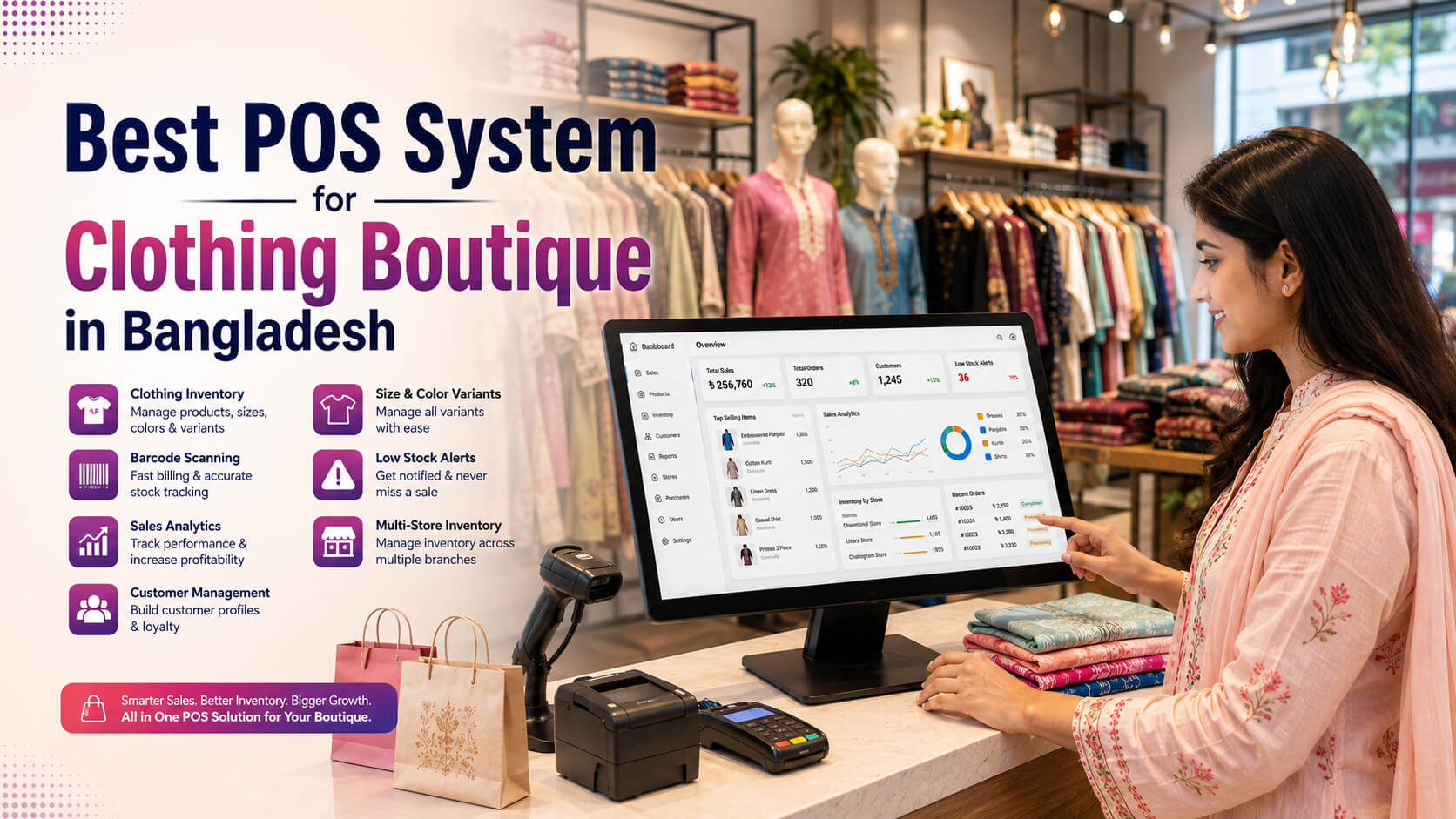
Best POS System for Clothing Boutique in Bangladesh
Discover the best POS system for clothing boutiques in Bangladesh. Compare top solutions for inventory, size and color variants, barcode billing, multi-store management, sales tracking, and ecommerce integration.
Running a clothing boutique involves much more than collecting payments. A single T-shirt may come in five sizes and six colors. Seasonal collections move quickly, exchanges are common, and stock may be split between a showroom, warehouse, Facebook orders, and an ecommerce website.
That is why choosing the best POS system for clothing boutique operations requires more than looking for basic billing software. A good system should help you track size and color variants, scan barcodes, manage inventory, process returns, monitor branches, understand sales trends, and maintain accurate business records.
For boutique owners in Bangladesh, local support, offline selling, VAT-related requirements, hardware compatibility, and payment workflows also deserve careful attention.
This guide compares eight practical options for clothing stores and fashion retailers, including Bangladesh focused POS providers and international platforms. It also explains what features matter, which systems fit different business models, and how to choose without paying for functions you do not need.
For most Bangladesh based clothing retailers, the best POS system for clothing boutique operations is one that handles size, color and style variants, barcodes, offline selling, returns, stock control and multi branch inventory. Mediasoft, DokanE and Nexchar are strong local options; Loyverse suits smaller budgets, while Shopify POS is attractive for ecommerce-focused retailers. A boutique POS system is retail software designed to process sales while managing the product variations, inventory movements and customer activity common in fashion retail. For a clothing business, ordinary billing is only the starting point. This is one of the most important apparel POS features. Suppose your boutique sells a linen shirt in: Those combinations should be treated as separate sellable variants while remaining connected to the same product. Without proper variant management, staff may know that "linen shirts" are in stock while having no idea whether the customer's medium olive shirt is actually available. Apparel oriented systems such as Mediasoft, Loyverse, Lightspeed, Odoo and ERPNext provide ways to organize products by attributes or variants. Every sale, return, purchase and stock transfer should update inventory. Look for a clothing store inventory and POS system that can answer questions such as: This is especially useful for fashion retailers because unsold seasonal stock can lose value quickly. Barcode scanning reduces manual item searches and speeds up checkout. A useful system should allow each product or variant to have its own SKU or barcode. For example, a medium black dress can have a different barcode from the same dress in large red. ERPNext supports barcodes on individual items, while Loyverse can assign barcodes at variant level. Lightspeed also provides barcode-label and scanning workflows. Fashion stores deal with exchanges frequently because of size, fit, color and gift purchases. Your POS software for clothing store operations should make it simple to: The operational question is not simply, "Can the software refund a sale?" It is, "Can an employee complete a real clothing-store exchange without creating inventory errors?" A growing boutique may begin with one store in Dhaka and later add a second showroom, warehouse or outlet. The POS should show stock by location and support transfers between them. DokanE advertises multi-branch and warehouse controls, while Shopify POS, Lightspeed and Loyverse also provide location-based inventory capabilities. Internet interruptions should not automatically stop checkout. For Bangladesh retailers, offline or resilient checkout can be particularly useful where connectivity is inconsistent. Nexchar states that its POS supports offline billing and synchronizes data when connectivity returns. When comparing any vendor, test offline behavior rather than assuming "cloud-based" automatically means offline capable. Bangladesh retailers should evaluate tax and recordkeeping requirements before selecting a system. The National Board of Revenue states that VAT related records may be maintained electronically and publishes current VAT resources and an official list of enlisted software firms. Mediasoft Data Systems Ltd. appears on that list. This does not mean every POS configuration automatically satisfies every business's VAT obligations. Requirements can vary by registration status, business activity and current regulations. Verify your specific setup with the NBR, your tax adviser and the POS provider before implementation. Quick takeaway: For a fashion retailer, prioritize variants, inventory, exchanges and branch control before decorative dashboards or rarely used features. The following systems stand out for different types of retailers. There is no single platform that is best for every boutique. Best for: Established clothing stores, fashion houses and multi location apparel retailers in Bangladesh. Mediasoft is one of the strongest local candidates because its clothing store software specifically supports size, color and style matrices. Its boutique offering also focuses on clothing and accessory inventory, stock distribution and loyalty features. A further Bangladesh specific consideration is that Mediasoft Data Systems Ltd. is listed by the NBR among enlisted software firms. Key strengths: Potential limitation: Public pricing is not always as transparent as self service international SaaS products, so businesses may need a consultation or quotation. Best choice when: Your main priority is a locally supported apparel POS system rather than generic retail billing software. Best for: Boutiques with seasonal collections, multiple outlets or warehouse operations. DokanE offers dedicated clothing-store and fashion-house POS pages. Its fashion software emphasizes product categories, collections, seasons, variations and style attributes, while its multi-branch solution supports warehouse and stock-transfer workflows. That combination makes it worth considering for a Bangladeshi fashion brand that expects to grow beyond one counter. Key strengths: Potential limitation: Ask for a detailed demo showing your exact variant structure, ecommerce workflow and accounting requirements before committing. Best choice when: You operate several outlets or want a boutique inventory management software solution with centralized stock visibility. Best for: Small and growing boutiques that want flexible access from mobile, desktop and web. Nexchar positions its Bangladesh POS for boutiques and other retailers. Its published features include inventory management, barcode billing, invoices, accounting, customer loyalty, online orders, reports and employee management. It also states that offline billing is supported, with data syncing after connectivity returns. Key strengths: Potential limitation: Clothing retailers should confirm how deeply the system handles size-color matrices and high-volume fashion variants during a live demonstration. Best choice when: You need a flexible POS system for small clothing business operations and want to manage sales from several device types. Best for: New boutiques, pop up stores and smaller fashion businesses. Loyverse is a global POS platform with a clothing specific use case. It supports item variants such as size and color, while each variant can have its own SKU, barcode, stock quantity and store-level settings. Its core POS is offered free, while more advanced inventory and management capabilities are available through paid add ons. Key strengths: Potential limitation: Bangladesh specific VAT, accounting and payment requirements may require separate processes or integrations. Best choice when: You want an affordable boutique POS system before investing in a larger retail platform. Best for: Fashion brands that already sell online through Shopify or want a unified ecommerce and retail workflow. Shopify POS connects in person sales with Shopify's ecommerce system. Orders and inventory can synchronize across retail locations, the online store and other active Shopify sales channels. This makes Shopify attractive when a customer might discover a dress online, visit the physical boutique to try it, and later order another color through the website. However, there is an important Bangladesh limitation: Bangladesh is not currently listed as a supported Shopify Payments country. Shopify says merchants in unsupported countries need to use an appropriate third-party payment provider. Key strengths: Potential limitation: Payment setup and hardware availability require extra planning in Bangladesh. Best choice when: Ecommerce is central to your business and you are prepared to verify a workable local payment setup. Best for: Growing retailers that want POS, inventory and wider business operations within an integrated ERP environment. Odoo supports product variants such as size, style and color. Its POS and inventory ecosystem also supports barcodes, employee access controls, loyalty and other retail workflows. Because Odoo extends beyond checkout, it can be useful when a fashion company also wants purchasing, inventory, accounting, CRM or broader ERP processes. Key strengths: Potential limitation: Configuration can become more involved than a simple plug and play POS. Local implementation quality matters. Best choice when: You want one platform to support more than retail checkout. Best for: Fashion businesses with technical support or an implementation partner. ERPNext combines POS with inventory and accounting functions. Its item-variant system explicitly supports apparel-style combinations: for example, a T-shirt template can have separate size and color variants. ERPNext POS also connects retail transactions with inventory and financial workflows and supports multiple payment methods and loyalty functions. Key strengths: Potential limitation: It usually demands more setup and technical knowledge than a simple subscription POS. Best choice when: Your business values customization and back office integration more than immediate out of the box simplicity. Best for: Larger or more sophisticated retailers evaluating an international apparel-focused platform. Lightspeed's apparel solution is specifically designed for clothing inventory and supports size and color variations, multi store inventory and unified online/offline stock. Its retail feature set also includes purchase orders, stock transfers, barcode labels and stock counts. Key strengths: Potential limitation: Before choosing Lightspeed in Bangladesh, verify current regional availability, payment integrations, hardware, support and total implementation cost. Best choice when: Your requirements are advanced enough to justify evaluating an international retail platform. Quick recommendation: For a Bangladesh-first clothing business, shortlist Mediasoft, DokanE and Nexchar first. Add Loyverse if cost is the main constraint and Shopify POS if ecommerce is the core of your growth strategy. Start with: Your priorities should be simplicity, barcode billing, variants, daily reporting and reliable support not enterprise features. Consider: Prioritize centralized inventory, branch transfers, user permissions, purchase orders and consolidated reporting. Shopify POS becomes especially relevant because Shopify can synchronize orders and inventory between its ecommerce platform and retail locations. Before choosing it in Bangladesh, solve the payment-provider and hardware questions first. Odoo or ERPNext may be better candidates than a basic clothing store POS system. The additional implementation effort can make sense when your business needs purchasing, inventory, accounting, warehouses and retail sales to operate within a connected system. Use this seven-step process. Write down the attributes you actually sell: Ask each vendor to demonstrate a real product with multiple combinations. Do not watch only the vendor's ideal sales demonstration. Ask the salesperson to simulate: A customer bought a medium black kurti yesterday and wants to exchange it today for a large blue version. Watch what happens to inventory. Disconnect the test device from the internet. Can staff still make a sale? What functions stop working? How does data synchronize afterward? If you have multiple locations, ask: Can my Dhanmondi salesperson see whether the Uttara branch has this size? That simple test reveals more than a long feature list. Check the latest NBR requirements relevant to your business, including VAT registration, recordkeeping and any required fiscal or software arrangements. NBR provides official VAT resources and maintains information on enlisted software firms. Do not rely solely on a salesperson's statement that a product is "VAT-ready." Include: A low monthly fee can become expensive if essential inventory features require several add-ons. Import 20–50 actual SKUs and variants. Then perform sales, exchanges, discounts, stock counts and end-of-day reporting before signing a long-term contract. Example 1: Preventing a Lost Sale A customer wants a medium blue panjabi, but the salesperson cannot find one on the rack. With location-based inventory, staff can check whether another branch has the item and arrange a transfer or pickup instead of simply saying it is unavailable. Example 2: Finding Slow-Moving Variants A boutique has sold most small and medium dresses from a collection, but large sizes remain. Variant-level reporting helps the owner see the difference. The next purchase order can be adjusted instead of repeating the same size mix. Example 3: Managing Eid or Festival Collections During high-demand periods, hundreds of new SKUs may arrive quickly. Barcode labels, bulk product imports, purchase orders and stock receiving become more valuable than manual spreadsheet entry. A good fashion boutique POS software setup makes it easier to know what arrived, what sold and what needs replenishment. A cheap invoice program may work initially but become frustrating when you need to track 40 combinations of one product. Always test variant management. Clothing retail has different operational demands from many other shops. A slow exchange process creates queues and inaccurate stock. Not every printer, scanner or terminal works with every POS. Choose the software first, then buy compatible hardware. International platforms may have country restrictions. For example, Square's official documentation currently lists payment processing in Australia, Canada, France, Ireland, Japan, Spain, the United Kingdom and the United States, not Bangladesh. Likewise, Shopify Payments does not currently list Bangladesh as a supported country. Check availability before building your business around a particular payment ecosystem. If you already have thousands of products in Excel or another system, ask how products, opening stock, customer records and historical data will be migrated. An advanced platform only creates value when your team actually uses its features. A reliable, simple POS can outperform a complex ERP implementation that cashiers struggle to operate. For many Bangladesh-based apparel retailers, Mediasoft, DokanE and Nexchar are sensible first options to evaluate. Mediasoft has apparel-specific size, color and style features, DokanE focuses on fashion and multi-branch operations, and Nexchar offers cloud access with offline billing. The best choice ultimately depends on store count, inventory complexity, ecommerce needs and budget. A clothing POS should support size and color variants, barcodes, inventory tracking, exchanges, purchasing, discounts and sales reports. Multi-store fashion retailers should also look for warehouse transfers, branch-level inventory and user permissions. Ecommerce synchronization becomes important when the same stock is sold both online and in physical stores. Yes, apparel-oriented POS systems can treat each size and color combination as an individual variant. For example, ERPNext documents how one T-shirt can have separate small, medium and large variants in several colors, while Loyverse also supports variant-level SKUs and barcodes. Cloud POS software is often convenient for small retailers because owners can access data from multiple devices and locations. However, check how the system behaves without internet access. A cloud system with a reliable offline mode may be more practical than one that becomes unusable whenever connectivity drops. Shopify POS can be useful for inventory and omnichannel retail, but Bangladesh merchants need to plan payments carefully. Shopify POS can synchronize physical and online orders and inventory, but Bangladesh is not currently listed among Shopify Payments-supported countries. Merchants therefore need to verify appropriate third-party payment arrangements and compatible local hardware. Square is not a practical choice for Bangladesh merchants who need Square's integrated payment processing. Square's official developer documentation currently lists payment processing in eight markets, including the US, UK, Canada and Australia, but not Bangladesh. Costs vary substantially depending on features, users, branches, hardware and implementation. Some products such as Loyverse provide a free core POS with paid advanced features, while locally implemented or ERP-style systems may use quotations, subscriptions or project-based pricing. Compare total ownership cost rather than choosing solely by the advertised monthly fee. Yes, once inventory becomes difficult to manage manually, a POS is usually more appropriate for daily operations. Excel remains useful for analysis and imports, but it does not automatically reduce stock after a sale, record exchanges, synchronize branches or restrict employee access. A POS is particularly valuable when one clothing style has many sizes and colors. The best POS system for clothing boutique businesses is the one that matches how your store actually sells, not the system with the longest feature list. For boutiques operating primarily in Bangladesh, Mediasoft, DokanE and Nexchar deserve an early place on the shortlist because they address local retail needs and provide Bangladesh-focused solutions. Loyverse is worth considering for smaller businesses seeking a lower cost entry point. For ecommerce led fashion brands, Shopify POS offers strong online to offline inventory capabilities, provided you verify a suitable Bangladesh payment setup. Odoo and ERPNext make more sense when broader ERP, inventory and accounting requirements justify additional configuration. Larger retailers can also evaluate Lightspeed, but should confirm Bangladesh availability, payments and support before making a decision.Direct Answer: What Is the Best POS Software for a Clothing Boutique?
What Should the Best POS System for Clothing Boutique Businesses Include?
1. Size, Color and Style Variants
2. Real Time Inventory Tracking
3. Barcode Billing
4. Returns and Exchanges
5. Multi Branch and Warehouse Control
6. Offline Selling
7. VAT and Business Records
Which Are the Best POS Systems for Clothing and Fashion Boutiques in Bangladesh?
1. Mediasoft Best Overall Local Apparel POS Fit
2. DokanE Best for Fashion Houses and Multi Branch Retail
3. Nexchar Best for Cloud Access With Offline Billing
4. Loyverse Best Budget-Friendly Boutique POS
5. Shopify POS Best for Online and Physical Store Integration
6. Odoo POS Best for Customizable Business Management
7. ERPNext Best Open Source Option for Inventory and Accounting
8. Lightspeed Retail Best Advanced Apparel Platform
How Do the Best Boutique POS Systems Compare?
POS System
Best For
Apparel Variants
Multi-Store
Offline Consideration
Bangladesh Fit
Mediasoft
Established local apparel retailers
Strong
Yes
Verify setup
Very strong
DokanE
Fashion houses and branches
Strong
Yes
Verify setup
Very strong
Nexchar
Growing boutiques
Verify depth
Yes
Advertises offline billing
Strong
Loyverse
Small/budget boutiques
Yes
Yes
Verify workflow
Good
Shopify POS
Ecommerce + retail
Yes
Yes
Limited offline functions should be tested
Moderate
Odoo POS
Custom ERP-style retail
Yes
Yes
Configuration dependent
Good with implementation
ERPNext
Open-source ERP/POS
Yes
Yes
Configuration dependent
Good with implementation
Lightspeed Retail
Advanced apparel operations
Strong
Yes
Verify regional setup
Requires verification
Which POS Is Best for Your Type of Clothing Business?
Small Single Store Boutique
Growing Fashion Brand With Several Outlets
Online Fashion Brand Opening a Physical Store
Apparel Business With Complex Accounting or ERP Needs
How Do You Choose the Right Clothing Store POS System?
Step 1: Map Your Product Variations
Step 2: Test a Real Exchange
Step 3: Check Offline Behavior
Step 4: Review Inventory by Branch
Step 5: Verify Bangladesh Tax Requirements
Step 6: Calculate Total Cost, Not Monthly Price
Step 7: Run a Trial With Real Products
Practical Examples: How the Right POS Helps a Fashion Boutique
What Are the Most Common POS Buying Mistakes?
Choosing Generic Billing Software
Ignoring Returns and Exchanges
Buying Hardware Before Selecting Software
Assuming Every International POS Works Fully in Bangladesh
Ignoring Data Migration
Paying for Features Staff Will Not Use
Expert Tips for Getting More Value From Boutique POS Software
Frequently Asked Questions
What is the best POS system for a clothing boutique in Bangladesh?
What features should a clothing store POS system have?
Can POS software manage different clothing sizes and colors?
Is a cloud POS better for a small clothing business?
Can Shopify POS be used by a clothing boutique in Bangladesh?
Is Square POS available in Bangladesh?
How much does fashion boutique POS software cost?
Should a boutique use POS software instead of Excel?
Conclusion: Which Clothing Boutique POS Should You Choose?