12 September, 2026
How Hospital ERP Software Improves Patient Care in Bangladesh
Hospital ERP software in Bangladesh helps hospitals improve patient care by integrating medical records, billing, laboratory services, pharmacy, and administrative workflows into one centralized system. This digital healthcare solution reduces delays, improves accuracy, enhances department coordination, and enables healthcare providers to deliver faster, more efficient patient services.
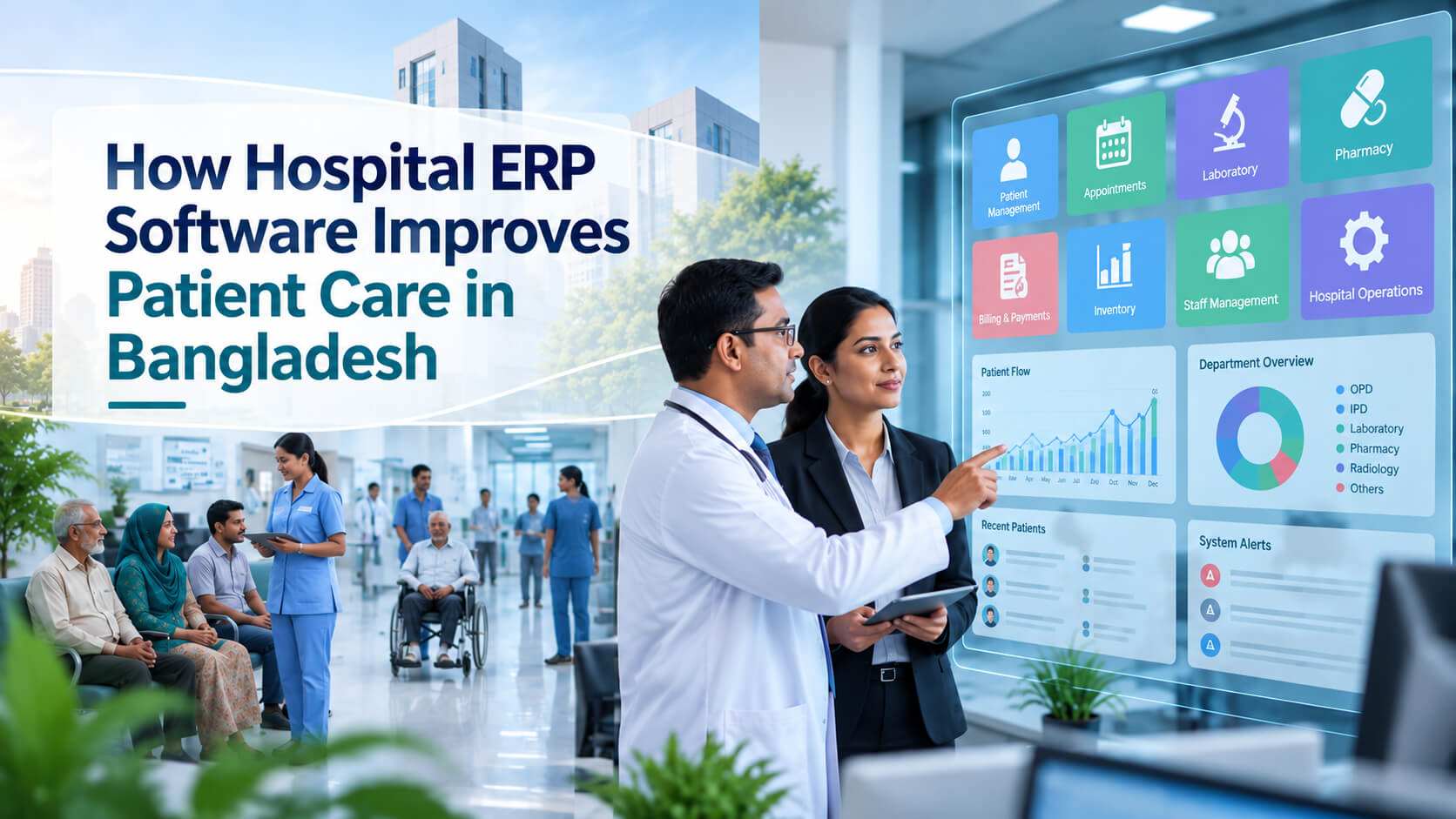
Healthcare organizations in Bangladesh are managing increasing patient volumes, complex administrative processes, and growing expectations for faster, safer, and more efficient services. Many hospitals still depend on disconnected systems, manual records, and traditional workflows that can delay patient care and create operational challenges. Hospital ERP software in Bangladesh helps healthcare providers solve these problems by connecting patient records, billing, inventory, laboratory services, pharmacy operations, appointments, and hospital administration through one integrated platform. For hospital owners, administrators, and IT managers, adopting a healthcare ERP system is not only about improving internal efficiency. It is about creating a smoother patient journey from registration and diagnosis to treatment, discharge, and follow-up. This article explains how hospital ERP solutions improve patient care, the key features hospitals should consider, practical implementation advice, and how healthcare organizations in Bangladesh can use technology to deliver better services. Hospital ERP software improves patient care in Bangladesh by connecting medical records, hospital departments, billing systems, inventory, laboratory services, and administrative workflows into one centralized platform. It reduces delays, improves data accuracy, enables faster decision-making, and helps doctors and healthcare teams provide more coordinated patient services. Hospital ERP software is an integrated healthcare management system that combines different hospital operations into a single digital platform. Unlike separate software systems used for billing, patient registration, pharmacy, or inventory, an ERP solution allows departments to share information in real time. A complete hospital ERP system may include: A Hospital Information Management System (HIMS) often overlaps with ERP capabilities because both aim to centralize healthcare information and improve operational coordination. Bangladesh's healthcare digitalization efforts increasingly focus on electronic health records, health information exchange, and connected healthcare systems. Healthcare providers in Bangladesh face several operational challenges: Hospitals and clinics are serving more patients every year. Managing appointments, medical histories, laboratory reports, and billing manually becomes difficult as patient numbers grow. A hospital workflow management system helps healthcare teams handle more patients without compromising service quality. Paper-based records can create problems such as: A digital healthcare solution allows authorized staff to access accurate patient information quickly. Hospitals involve multiple departments: Without integration, communication gaps can affect patient experience. Hospital ERP solutions create a connected environment where departments work from the same information source. The first patient interaction with a hospital often begins at registration. Long waiting times can negatively affect patient satisfaction. Hospital ERP software improves this process by allowing: For example, when a returning patient visits a hospital, staff can quickly retrieve previous records instead of creating a new file. Patient Care Impact: Reduced waiting time, faster consultation process, better patient experience. Doctors need accurate information to make informed treatment decisions. A healthcare ERP system Bangladesh hospitals use can store: This helps physicians understand the patient's condition without depending on incomplete paperwork. Patient Care Impact: More accurate diagnosis, better treatment planning, reduced chances of missing important medical information. A patient's treatment involves multiple teams. For example: An integrated ERP system reduces unnecessary communication delays between departments. Patient Care Impact: Faster diagnosis, better coordination, improved treatment efficiency. Diagnostic delays can affect treatment decisions. Hospital ERP software can help manage: Integration between clinical departments allows healthcare providers to access important information at the right time. Financial processes directly affect patient experience. Common billing problems include: ERP software automates billing workflows and improves financial accuracy. Benefits Include: Medicine availability is essential for quality healthcare. Healthcare automation software helps hospitals monitor: A hospital can receive alerts before important medicines run out. Patient Care Impact: Reduced treatment delays, better medicine availability, improved resource planning. Modern ERP systems provide reports and dashboards that help hospital managers understand: Healthcare administrators can use this information to improve service delivery. Before selecting a system, hospitals should evaluate essential features. Important capabilities: A strong EMR system should provide: Look for: Important features: Hospitals should have access to: Consider a patient visiting a private hospital in Dhaka. Without ERP: With Hospital ERP: The result is a smoother, faster healthcare experience. The cheapest option may not meet hospital requirements. Hospitals should evaluate: Even good software fails if employees do not understand how to use it. Proper training should be part of implementation. Hospitals should prepare a clear strategy for transferring existing patient records. Healthcare software requires knowledge of: Define what problems the hospital wants to solve: The system should support future growth, including: Healthcare information is sensitive. Hospitals should consider: Hospital ERP software in Bangladesh is an integrated healthcare management platform that helps hospitals manage patient records, billing, inventory, laboratory operations, and administration through a centralized system. It improves workflow efficiency and supports better patient care. ERP software improves patient care by reducing delays, providing faster access to medical records, improving communication between departments, and helping healthcare professionals make informed decisions using accurate information. Yes. Many ERP solutions can be customized for clinics, diagnostic centers, and hospitals of different sizes. Smaller healthcare facilities can start with essential modules and expand as their requirements grow. A Hospital Information Management System (HIMS) mainly focuses on healthcare operations such as patient records and clinical workflows. Hospital ERP software usually includes these functions along with broader business management features like finance, inventory, HR, and reporting. The cost depends on factors such as hospital size, required modules, customization, deployment method, and support requirements. Hospitals should request a solution assessment rather than choosing software based only on price. Yes. Many healthcare ERP systems support integration with laboratory, pharmacy, billing, and inventory modules to create a connected hospital workflow. A properly implemented ERP system should include security measures such as access controls, backups, and secure data management practices. Hospitals should evaluate security features before implementation. Hospital ERP software in Bangladesh helps healthcare organizations move from disconnected processes to a coordinated digital healthcare environment. By integrating patient records, medical workflows, billing, inventory, and reporting, ERP systems enable hospitals to deliver faster and more organized patient services. For hospital owners, administrators, and IT managers, the right ERP solution is not simply an operational tool. It is an investment in better patient experiences, improved decision-making, and sustainable healthcare management. Hospitals planning digital transformation should evaluate their current challenges, define their goals, and choose a scalable healthcare ERP system that matches their operational needs.Direct Answer
What Is Hospital ERP Software?
Why Do Hospitals in Bangladesh Need ERP Software?
1. Increasing Patient Demand
2. Manual Data Management Problems
3. Lack of Department Coordination
How Hospital ERP Software Improves Patient Care in Bangladesh
1. Faster Patient Registration and Appointment Management
2. Provides Complete Patient Medical History
3. Improves Communication Between Healthcare Departments
4. Enables Better Laboratory and Diagnostic Management
5. Reduces Billing Errors and Improves Transparency
6. Improves Pharmacy and Inventory Management
7. Supports Better Clinical Decision-Making
Hospital ERP Software vs Traditional Hospital Management
Area Traditional System Hospital ERP Software Patient Records Paper/manual files Digital centralized records Department Communication Separate processes Integrated workflow Billing Manual calculations Automated billing Inventory Manual tracking Real-time monitoring Reporting Time-consuming Instant analytics Patient History Difficult retrieval Quick access Key Features to Look for in ERP Software for Hospitals and Clinics
Patient Management Module
Electronic Medical Records
Billing and Accounting Integration
Pharmacy and Inventory Management
Reporting and Analytics
Practical Example: How ERP Improves a Patient Journey
Common Mistakes Hospitals Make When Implementing ERP Software
1. Choosing Software Based Only on Price
2. Ignoring Staff Training
3. Not Planning Data Migration
4. Selecting Software Without Healthcare Experience
Expert Tips for Successful ERP Implementation
Start With Clear Goals
Choose Scalable Technology
Prioritize Data Security
Frequently Asked Questions
What is hospital ERP software in Bangladesh?
How does ERP software improve patient care?
Is hospital ERP software suitable for small clinics?
What is the difference between HIMS and hospital ERP software?
How much does hospital ERP software cost in Bangladesh?
Can hospital ERP software integrate with laboratory and pharmacy systems?
Is patient data secure in hospital ERP systems?
Conclusion