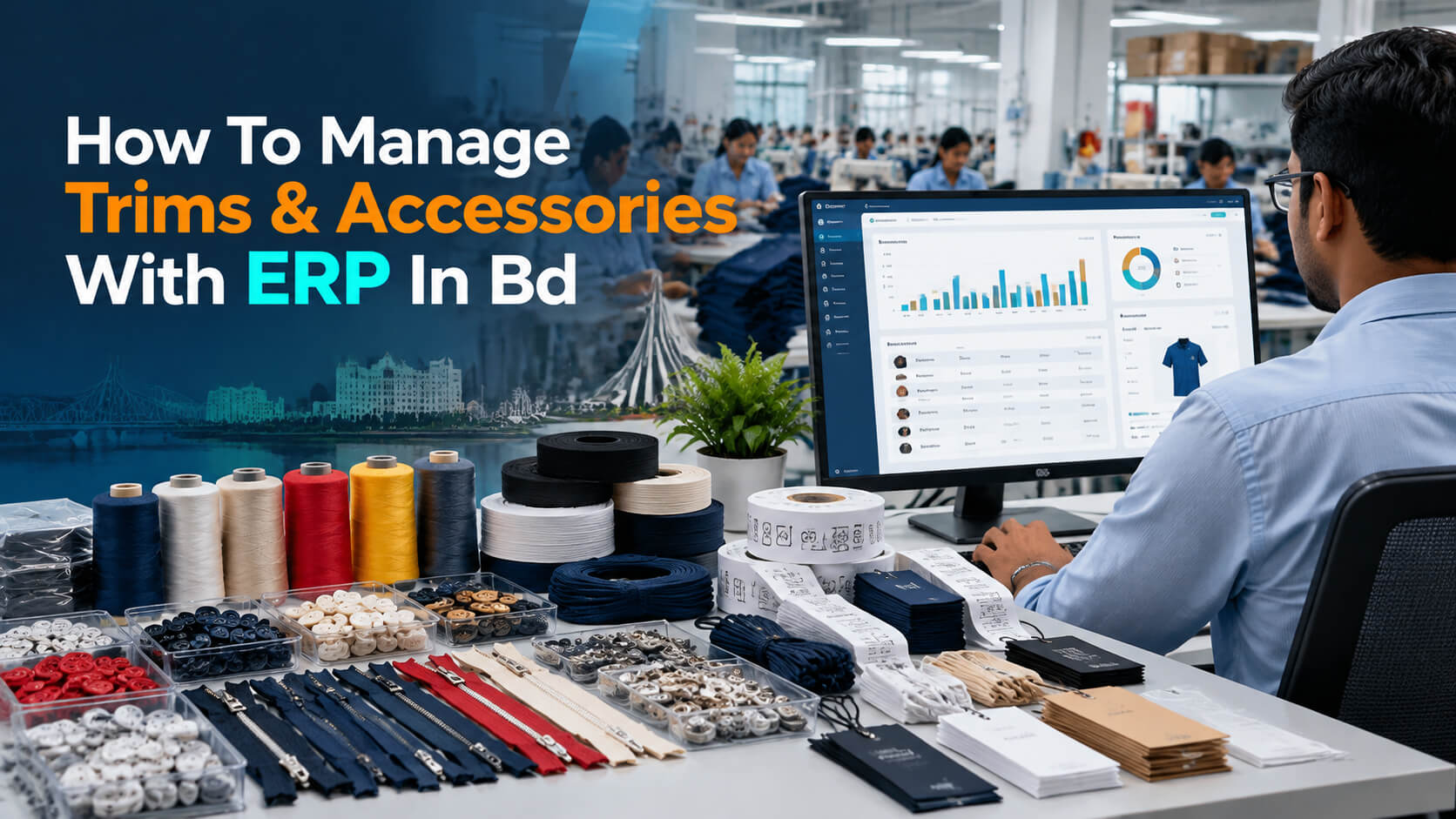
24 October, 2026
How To Manage Trims & Accessories With ERP in Bd
Learn how trims and accessories ERP in Bangladesh helps garment manufacturers streamline inventory management, track material requirements, manage purchase orders, reduce stock shortages, and improve production efficiency through integrated ERP solutions.
A garment order can be ready for production, yet a missing zipper, incorrect button shade, delayed label delivery, or shortage of sewing thread can disrupt the entire schedule. For garment manufacturers and apparel exporters in Bangladesh, managing these small but essential materials is a critical part of production planning. When teams track trims and accessories through separate spreadsheets, paper records, and manual warehouse updates, it becomes difficult to know what is available, what has been ordered, and what is still awaiting approval. These gaps can lead to excess purchasing, material shortages, and delayed shipments. Implementing trims and accessories ERP Bangladesh workflows can help factories connect material planning, purchasing, inventory, quality checks, and production requirements in one system. This guide explains how ERP software supports these processes, which features matter most, and how garment manufacturers can implement a practical inventory management workflow. Trims and accessories management is the process of planning, purchasing, receiving, storing, issuing, and tracking the non-fabric materials required to manufacture garments. Common examples include: An Enterprise Resource Planning (ERP) system connects these activities with purchase orders, bills of materials (BOMs), inventory records, and production orders. Instead of maintaining separate records for each department, authorized employees can work from shared, transaction-based information. The available functionality depends on the ERP product and how the factory configures it. Trims and accessories ERP Bangladesh workflows help factories coordinate material requirements with purchasing, warehouse operations, and production schedules. An ERP system can centralize stock records, calculate material demand from approved BOMs, monitor supplier deliveries, and record material issues against specific orders. It can also flag shortages before production begins, provided that inventory and order data are accurate and updated promptly. For Bangladesh's export-oriented apparel sector, this coordination is particularly relevant because factories must align material availability with buyer specifications and shipment deadlines. The Bangladesh Investment Development Authority identifies textiles and apparel as a major national manufacturing and export sector. The first step is to establish a consistent item master for every trim and accessory. Each item should have a unique code and clearly defined attributes, such as: For example, a factory should not maintain separate, inconsistent descriptions such as "black button," "button black 18L," and "18L BK button" when they refer to the same approved item. A standardized database reduces duplicate records and helps purchasing and warehouse teams identify the correct material. Practical recommendation: Establish item naming rules and obtain approval from merchandising, procurement, and inventory teams before importing existing stock records into the ERP. A bill of materials specifies the components required to manufacture a particular garment style. It may include fabric, thread, buttons, labels, zippers, packaging, and other accessories. BOM management in garment manufacturing allows ERP software to calculate material requirements from order quantities and approved consumption rates. Consider a hypothetical order for 10,000 shirts. If each shirt requires seven buttons, the gross requirement is: 10,000 shirts × 7 buttons = 70,000 buttons. If the approved planning allowance is 3%, the planned requirement becomes 72,100 buttons. The factory must then consider usable stock, existing allocations, incoming deliveries, and the applicable planning policy before determining how many additional buttons to purchase. A simplified planning formula is: Net requirement = Gross material requirement + approved allowance − usable available stock − confirmed incoming supply. Actual ERP calculations may also account for reservations, safety stock, quality holds, and other planning rules. This process helps merchandisers and procurement teams identify shortages before the materials are needed on the production floor. Manual purchasing becomes difficult when several garment orders require similar accessories from different suppliers. ERP-based garment purchase order management connects material requests with supplier quotations, approved purchases, expected delivery dates, and goods receipt records. A practical workflow includes: For example, if a factory needs 50,000 printed labels and the supplier confirms delivery in two batches, the ERP should distinguish the ordered quantity from the quantity already received. This makes it easier to identify outstanding deliveries and follow up with suppliers before material shortages affect production. Accurate inventory information is essential for deciding whether a factory can fulfil its material requirements. An apparel inventory management system should record stock movements rather than relying only on periodic manual updates. Useful functions include: Barcode scanning can improve transaction speed and reduce manual entry errors, but it works only when item labels, scanners, and operating procedures are properly configured. Factories should also distinguish between physical stock and usable stock. Materials awaiting inspection, rejected accessories, and items reserved for another order should not automatically be treated as available for new production. The key principle: Every material movement should have a documented transaction, a responsible user, and a clear reference to the relevant order or warehouse location. A material can be physically available but still unsuitable for production. Buttons may have the wrong colour, labels may contain incorrect information, and zippers may fail an inspection. ERP workflows should therefore connect incoming materials with the appropriate inspection and approval status. A practical quality-control process records: Where buyer approval is required, the system should help employees identify which materials have been approved for a specific style or order. The ERP does not replace physical inspection or buyer approval. It provides a structured way to record decisions and prevent unapproved stock from being issued inadvertently. Material planning should reflect when accessories are needed, not just how many units are required. An ERP system can connect production plans with material availability and supplier lead times. Merchandisers and production planners can use this information to identify potential shortages before a line starts work. For example, if the fabric for a shirt order is ready but the care labels are delayed, a material availability report can show that the order is not fully ready for production. Teams can then expedite the delivery, revise the sequence of production orders, or make another approved operational adjustment. These decisions remain dependent on accurate dates, realistic supplier lead times, and reliable inventory transactions. ERP software improves visibility; it cannot eliminate supplier delays or guarantee on-time delivery. A well-configured ERP system provides information that helps managers identify waste, purchasing inefficiencies, and recurring material shortages. Managers should review these reports regularly and assign responsibility for investigating significant exceptions. For example, repeated differences between planned and actual thread consumption may indicate inaccurate BOM assumptions, inconsistent issuing practices, or avoidable production waste. The report helps identify where further investigation is needed rather than automatically revealing the root cause. ERP is not automatically more accurate than a spreadsheet. Incorrect master data, missing transactions, and poorly configured workflows can create unreliable reports in either environment. The main advantage of ERP is its ability to connect processes and enforce consistent controls when implemented correctly. Suppose a garment exporter receives an order for 20,000 polo shirts. Each shirt requires five buttons, one main label, one care label, and one hangtag. The merchandising team approves the BOM, and the ERP calculates the total requirement for each item. The warehouse then checks usable stock and existing reservations. Procurement purchases the remaining quantities and records supplier delivery commitments. When the accessories arrive, the warehouse records the received quantities and sends materials for inspection where necessary. Only accepted quantities are released for production. The system records material issues against the order, allowing managers to compare consumption with the original plan. If the hangtags arrive late, the team can see the outstanding quantity and its impact on material readiness. This gives procurement and production planners time to respond rather than discovering the shortage after production has started. This example is illustrative. The exact workflow depends on the factory's buyer requirements, approval procedures, and ERP configuration. Even a capable ERP system can produce poor results when the underlying process is weak. Common mistakes include: A phased implementation, beginning with a selected group of materials or production orders, can help the factory identify data and process problems before expanding to all departments. For garment manufacturers evaluating ERP in Bangladesh, the following checklist provides a practical starting point: Select garment ERP software in Bangladesh based on the factory's actual requirements, not simply the number of features in a product demonstration. Check whether the system supports the required workflows, reporting, integrations, user permissions, and implementation support. Trims and accessories ERP in Bangladesh refers to using enterprise resource planning software to manage garment components such as buttons, zippers, labels, thread, and packaging materials. It connects material planning, procurement, inventory, quality checks, and production orders so factory teams can coordinate stock availability with manufacturing requirements. ERP can identify shortages by comparing material demand with usable stock, reservations, and confirmed incoming supply. When data is accurate, procurement teams can see which accessories need to be ordered and when they are required. Alerts and delivery tracking help employees respond earlier, although supplier delays and inaccurate data can still cause shortages. Yes. An ERP system with BOM and material planning functionality can calculate requirements from approved garment specifications and order quantities. Depending on the configuration, it can also consider allowances, existing inventory, reserved stock, and incoming purchase orders. Teams must maintain accurate BOMs and review material assumptions to ensure the calculations are reliable. Prioritize BOM management, inventory tracking, purchase order management, supplier delivery monitoring, quality inspection records, material reservations, and production planning. Multi-warehouse support, barcode scanning, role-based approvals, and relevant management reports may also be important. The best feature set depends on factory size, product complexity, buyer requirements, and existing business processes. Yes. Smaller factories can start with core item records, stock transactions, purchase orders, and material requirements before introducing more advanced features. The implementation should match the factory's budget, staff capacity, and operational complexity. A phased rollout can reduce disruption and allow the team to establish reliable inventory practices before expanding the system. Implementation time depends on the number of warehouses, material records, integrations, approval workflows, and existing data quality. A limited pilot may be completed faster than a factory-wide deployment, but no single timeline applies to every business. Before committing, ask the ERP provider for a project plan covering data migration, testing, staff training, and go-live support. ERP can reduce errors by standardizing item codes, recording transactions, applying approval rules, and connecting inventory movements with purchase and production orders. It cannot eliminate every error. Employees may still enter incorrect quantities, skip transactions, or use inaccurate master data. Physical stock counts, reconciliation, training, and access controls remain important. Start by documenting current inventory and procurement problems, then compare systems against specific requirements. Ask providers to demonstrate a complete workflow using a realistic garment order, from BOM calculation and purchasing through goods receipt, inspection, and production issue. Also evaluate implementation costs, local support, integration needs, data security, and the ability to scale. Effective trims and accessories management requires more than knowing how many buttons, labels, or zippers are in the warehouse. Factories need to connect material requirements with purchasing, quality approval, stock availability, and production schedules. A properly configured ERP system can make these processes more transparent, help teams identify shortages earlier, and support better purchasing and inventory decisions. Results depend on accurate data, clear responsibilities, disciplined transactions, and appropriate staff training. For garment manufacturers and apparel exporters in Bangladesh, the most practical starting point is to standardize material records, validate BOMs, and map the current purchasing and warehouse workflow. Then evaluate an ERP solution against those requirements before expanding the implementation across the factory.What Is Trims and Accessories Management in ERP?
How Does Trims and Accessories ERP Bangladesh Help Garment Factories?
1. Create a Standardized Trims and Accessories Database
2. Connect BOM Management with Material Planning
3. Automate Garment Purchase Order Management
4. Improve Trims Inventory Management and Warehouse Control
5. Track Material Quality and Buyer Specifications
6. Coordinate Accessories with Production Schedules
7. Use Reports to Control Inventory Costs
ERP report How the factory can use it Stock availability Identify usable quantities and shortages Material requirement report Calculate demand by order or style Purchase order status Monitor outstanding supplier deliveries Slow-moving inventory Review accessories with limited usage Stock variance report Investigate differences between recorded and physical stock Material consumption report Compare planned and actual usage Supplier delivery report Evaluate delivery performance using recorded dates ERP vs. Spreadsheet-Based Trims Management
Area Spreadsheet-based process ERP-based process Stock visibility Depends on manual updates Shared records updated through transactions Material planning Often requires manual calculations Can calculate demand from configured BOMs Purchase tracking Separate files and follow-ups Purchase orders linked to receipts and outstanding quantities Quality control May rely on separate documents Inspection status can be connected to inventory Reporting Requires manual consolidation Can generate reports from recorded transactions Access control Depends on file permissions Can use role-based permissions and approval workflows A Practical Example for a Bangladesh Garment Factory
Common Mistakes to Avoid When Implementing ERP
Best Practices for Successful ERP Implementation
Frequently Asked Questions
1. What are trims and accessories ERP in Bangladesh?
2. How does ERP reduce trim shortages in garment factories?
3. Can ERP calculate trims and accessories requirements automatically?
4. Which ERP features are important for Bangladesh garment manufacturers?
5. Can small garment factories use ERP for accessories inventory?
6. How long does ERP implementation take for trims management?
7. Does ERP eliminate manual inventory errors?
8. How should a factory choose garment ERP software in Bangladesh?
Conclusion